

NAVIGATING A MARKET THAT NO LONGER WAITS
As we move into April, it’s clear that the fuel landscape has shifted from predictable cycles to real-time global impact. The escalation of tensions between the United States and Iran has once again highlighted how quickly international events translate into local cost pressures here in South Africa.
For our customers, this is not just about rising prices — it’s about operational certainty in an increasingly uncertain market. Diesel remains the backbone of your business, whether you are moving goods, running fleets, powering equipment, or maintaining uptime during ongoing energy challenges. When global supply routes are threatened, the ripple effect is immediate, and the pressure on margins is real.
At Eco Diesel, our focus remains on what matters most: reliability, quality, and consistency of supply. In times like these, having a dependable fuel partner is not a luxury — it is a necessity. We are actively monitoring market conditions, securing supply channels, and ensuring that our customers continue to operate without disruption.
While we cannot control global events, we can control how we respond to them. And our commitment is simple — to stand alongside our customers with certainty, insight, and service that keeps your business moving forward.
Let’s navigate this together.
THE R8 REALITY: WHEN GLOBAL WAR HITS YOUR DIESEL TANK
South Africa is once again feeling the full force of global geopolitics — and this time, it’s hitting harder than most expected. The escalating conflict between the United States and Iran has disrupted one of the world’s most critical oil supply routes: the Strait of Hormuz. With nearly 20% of global oil flowing through this corridor, any instability immediately translates into higher fuel costs worldwide.
For South African businesses, the impact is direct and unavoidable. Diesel under-recoveries have already surged, with projections pointing to increases of up to R8 per litre. This is not just a number — it’s a fundamental shift in operating costs across transport, mining, agriculture, and construction sectors.
Unlike previous cycles, this spike is driven by both supply risk and market fear. Oil prices have surged past $100 per barrel, while the rand has weakened, amplifying the landed cost of fuel. The result is a compounded pricing effect that businesses cannot absorb indefinitely.
For fleet operators and heavy industry, diesel is not discretionary — it is the backbone of operations. Every kilometre travelled, every generator running during load shedding, and every piece of equipment on-site now carries a higher cost burden.
The reality is clear: global conflict is no longer distant news — it is a direct line item on your balance sheet. Businesses that recognise this early and adjust procurement strategies will be in a stronger position to navigate the volatility ahead.
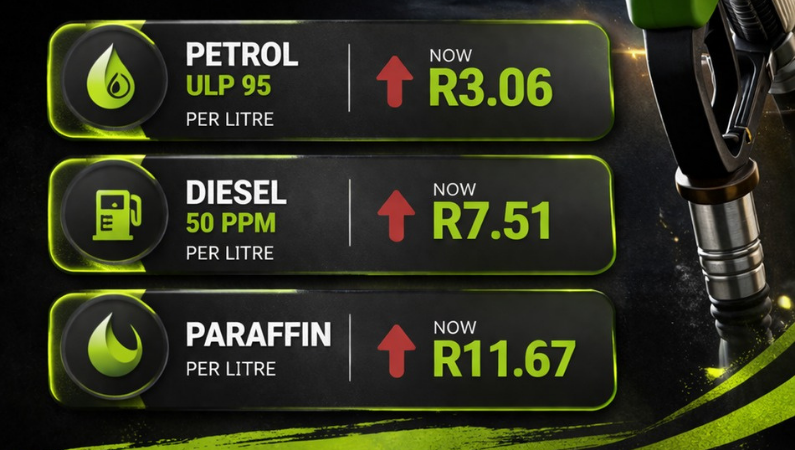
FUEL UPDATE: APRIL PRICES. REAL IMPACT
THE STRAIT EFFECT: WHY A MIDDLE EAST CONFLICT SHAPES SOUTH AFRICA’S ECONOMY
The Strait of Hormuz may be thousands of kilometres away, but its influence on South Africa’s economy is immediate and profound. As tensions rise and shipping routes become threatened or restricted, global oil supply tightens — pushing prices higher across the board.
South Africa, as a net importer of refined fuel, is particularly vulnerable. Unlike oil-producing nations, the country relies heavily on imported diesel to power its economy. When supply routes are disrupted, the cost of securing fuel increases, and those costs filter directly into local pricing structures.
The knock-on effect is widespread. Transport costs rise, increasing the price of goods. Agricultural producers face higher input costs, impacting food prices. Mining operations, which rely heavily on diesel-powered machinery, see margins tighten. Even small businesses feel the pressure through increased logistics and energy costs.
What makes this situation more complex is the uncertainty. Markets are reacting not only to current disruptions but also to potential escalation. If tensions persist or intensify, oil prices could remain elevated for an extended period — creating sustained pressure on the South African economy. This is not a short-term spike; it is a structural risk that requires strategic planning. Businesses that understand the global-to-local connection will be better positioned to make informed decisions in an increasingly volatile environment.
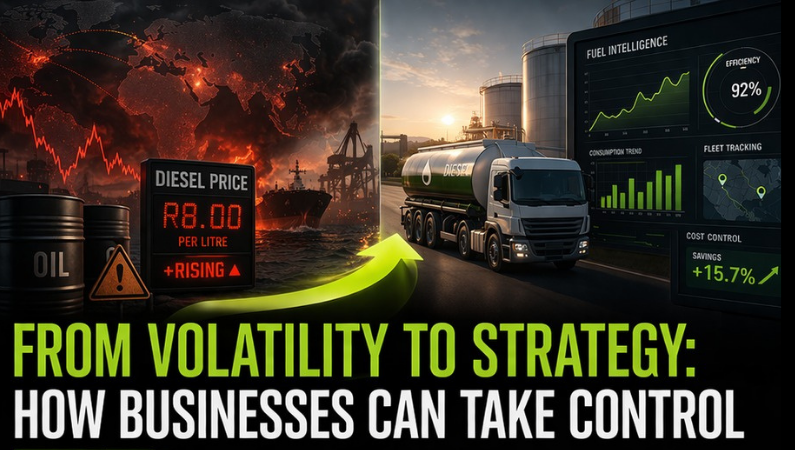
The current fuel market is no longer predictable — it is reactive, fast-moving, and deeply influenced by global events. The Iran–US conflict has demonstrated just how quickly conditions can shift, leaving businesses exposed to sudden and significant cost increases.
However, volatility does not have to mean vulnerability.
Forward-thinking businesses are shifting their approach from reactive purchasing to strategic fuel management. This begins with visibility — understanding consumption patterns, identifying inefficiencies, and forecasting demand more accurately. Without this insight, companies are effectively navigating blind in a volatile market.
Securing supply is equally critical. In times of global disruption, availability can become just as important as price. Businesses that rely on ad hoc purchasing may face delays or inconsistent supply, which can disrupt operations far more severely than price increases alone.
Another key strategy is supplier alignment. Working with a fuel partner that understands market dynamics, communicates proactively, and ensures consistent quality can significantly reduce operational risk. Reliable supply chains become a competitive advantage when markets are unstable.
Operational efficiency also plays a major role. Route optimisation, fleet maintenance, and fuel usage monitoring can all contribute to reducing consumption without compromising productivity. In a high-cost environment, small efficiencies translate into meaningful savings.
The reality is that fuel is no longer just a cost — it is a strategic asset. Businesses that treat it as such will be better equipped to manage uncertainty, protect margins, and maintain operational continuity. In a market shaped by global conflict, control comes from preparation, not prediction.
DIESEL DRIVES EVERYTHING: THE HIDDEN INFLATION ENGINE
Diesel is often overlooked in public discussions around fuel pricing, but in reality, it is one of the most important drivers of inflation in South Africa. Unlike petrol, which primarily affects motorists, diesel powers the movement of goods, machinery, and essential services across the economy.
As diesel prices climb sharply due to global conflict, the ripple effect becomes unavoidable. Every product transported by road — from food to construction materials — carries an increased cost. These increases eventually reach the end consumer, contributing to broader inflation.
For industries such as logistics and agriculture, the impact is immediate. Transport companies face higher operational costs, forcing them to adjust pricing or absorb reduced margins. Farmers encounter rising fuel expenses during planting and harvesting seasons, which ultimately affects food supply chains.
The compounding effect is what makes diesel price increases particularly challenging. It is not a once-off adjustment but a continuous pressure that builds across multiple sectors simultaneously.
In this environment, cost control becomes critical. Businesses that actively monitor fuel usage, optimise routes, and secure reliable supply agreements will have a competitive advantage. Those that do not may find themselves exposed to escalating operational costs with limited room to manoeuvre.
Diesel does not just power engines — it powers the economy. And when its price rises, everything else follows.
BEYOND APRIL: WHAT HAPPENS IF THE WAR CONTINUES?
While April’s projected fuel price increases are already significant, the bigger question is what lies ahead. If tensions between the United States and Iran persist, the current market conditions may not only continue — they could intensify.
Oil markets are highly sensitive to prolonged instability. Continued threats to the Strait of Hormuz or further escalation in the region could push oil prices well beyond current levels. For South Africa, this would mean sustained upward pressure on both petrol and diesel prices.
A prolonged conflict would also increase competition for available fuel supplies. Countries may begin securing strategic reserves, tightening global availability and driving prices even higher. For import-dependent economies like South Africa, this creates an additional layer of risk.
The impact on local industries would be significant. Transport costs would remain elevated, affecting supply chains across the country. Manufacturing and mining sectors could face increased operational pressure, while agriculture would continue to battle rising input costs.
At a macro level, sustained high fuel prices contribute to inflation, reduce consumer spending power, and slow economic growth. This creates a challenging environment for businesses already operating under tight margins.
However, prolonged disruption also creates a shift in how businesses operate. Companies are forced to become more efficient, more strategic, and more resilient. Those that adapt quickly — by securing supply, improving efficiency, and aligning with reliable partners — will be better positioned to navigate the uncertainty.
The key takeaway is simple: this is not just an April issue. It is a developing global situation with long-term implications. Businesses that plan beyond the immediate horizon will be the ones that remain competitive in the months ahead.