


October has been a powerful reminder of how quickly the energy landscape can change. Events thousands of kilometres from South Africa are influencing international oil markets, refining capacity, shipping routes and the cost of diesel here at home. For our customers, this makes access to a dependable fuel partner increasingly important. At Eco Diesel, our focus remains on understanding the market, responding to change and providing the reliable bulk diesel supply and service businesses need to keep moving. As we enter the final quarter of 2026, I would like to thank our customers for their continued trust and partnership. Whatever the market brings next, we remain committed to helping you navigate it with confidence — and to keeping South African businesses moving forward.
Jessica LeGrange
Chief Executive Officer
Eco Diesel

Why an attack thousands of kilometres away matters to South African diesel users
A drone attack on Saudi Arabia’s critical East-West oil pipeline in September delivered another reminder of just how interconnected the global fuel market has become.
The 1,200km pipeline has played an increasingly important role in moving Saudi crude to the Red Sea while disruption around the Strait of Hormuz has complicated traditional export routes. Following the attack, the pipeline was shut down, threatening a route that had been carrying around four million barrels per day — approximately 4% of global oil supply. Brent crude subsequently climbed above $108 per barrel.
For South African businesses, this is not simply international news.
South Africa imports crude oil and finished petroleum products at internationally determined prices. When major producing regions experience disruption, the impact can travel rapidly through global oil prices, shipping costs, refined-product availability and ultimately the local diesel price.
October demonstrated that exposure clearly. The wholesale price of 0.005% sulphur diesel increased by approximately R3.24 per litre from 7 October, with government citing higher crude prices, uncertainty around oil flows, increased shipping costs and declining global petroleum-product inventories.
The lesson for diesel-dependent businesses is increasingly clear: geopolitical risk has become an operational risk.
Mining, agriculture, construction, manufacturing and logistics companies cannot control events in the Middle East. They can, however, understand their consumption, forecast demand and build stronger fuel strategies around periods of volatility.
In today’s market, reliable bulk diesel supply in South Africa is about more than filling a tank.
It is about protecting business continuity when events on the other side of the world suddenly arrive on your balance sheet.
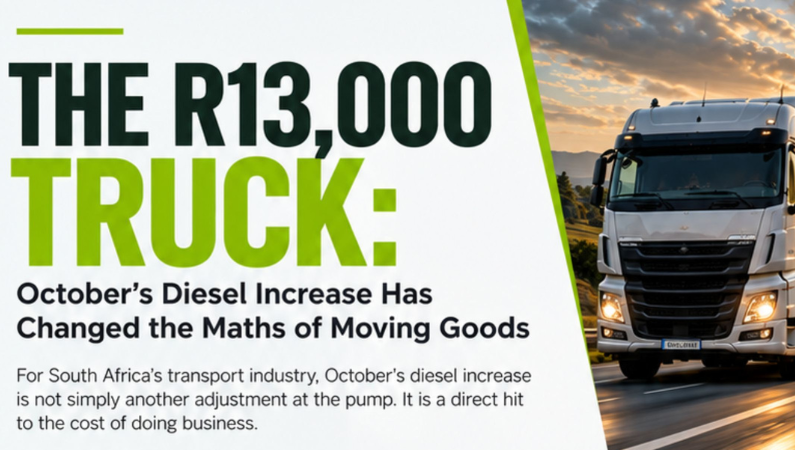
From 7 October, the wholesale price of 0.005% sulphur diesel increased by approximately R3.24 per litre. For a truck consuming 4,000 litres a month, that translates into almost R13,000 in additional monthly fuel costs.
Multiply that across a fleet of 10, 50 or 100 vehicles and the scale of the challenge changes dramatically.
Fuel can represent between 35% and 55% of a road-freight operator’s operating costs, depending on routes, vehicle type and operation. The problem is that freight rates do not always change as quickly as diesel prices. Transporters may therefore have to absorb higher costs until contracts can be reviewed — putting immediate pressure on cash flow and margins.
But the impact does not stop with transport companies.
Diesel moves South Africa. It moves food from farms, raw materials to factories, construction materials to sites and finished products into warehouses and stores. When the cost of moving those goods rises, the effect travels through the entire South African supply chain.
For businesses operating vehicle fleets, October creates a powerful reason to scrutinise every kilometre.
Are delivery routes optimised? Are vehicles returning empty? Is excessive idling being measured? Are loads being consolidated effectively? Can deliveries be scheduled differently?
The objective is no longer simply to manage the diesel price. It is to understand the cost of every movement diesel enables.
Businesses cannot control global oil prices. But they can control how efficiently fuel becomes kilometres, deliveries and revenue.
When every kilometre costs more, every kilometre needs to count.
One In Every Four Import Rands
South Africa’s Fuel Dependency Has Reached a New High
Here is a number every fuel-dependent South African business should know: 24.5%.
In the second quarter of 2026, crude oil and refined petroleum products accounted for almost a quarter of the value of South Africa’s imports — the highest proportion recorded since 1994. That was a sharp increase from 15.9% in the previous quarter.
The South African Reserve Bank has also highlighted a significant increase in the value of imported refined petroleum products, driven particularly by diesel, petrol and aviation kerosene as global fuel prices climbed amid war-related supply concerns.
This matters because it exposes an important reality about South Africa’s energy economy.
Our businesses may operate locally, but a significant portion of the fuel powering those operations is connected to international markets.
South Africa imports both crude oil and finished petroleum products at internationally influenced prices. Shipping costs, exchange rates, refinery availability, global inventories and geopolitical events can therefore move rapidly from international headlines into South African operating budgets.
That makes fuel procurement increasingly strategic.
The conversation is no longer simply: What price can I get today?
Businesses should also be asking: How exposed are we to sudden market movements? What does our next 30, 60 or 90 days of diesel demand look like? Which operations are most vulnerable to a major price movement? And do we have a fuel partner capable of responding when conditions change?
For mines, farms, logistics operators, manufacturers and construction businesses, diesel is too important to be treated as an ordinary purchase.
The international fuel market will remain unpredictable. South African businesses cannot remove that exposure completely.
They can, however, become better prepared for it.
In a market increasingly shaped beyond our borders, knowing your fuel requirements before you need them is becoming a competitive advantage.
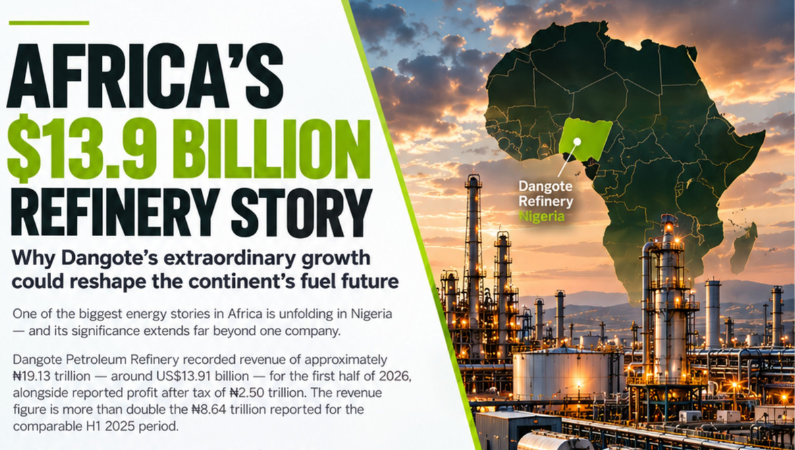
One of the biggest energy stories in Africa is unfolding in Nigeria — and its significance extends far beyond one company.
Dangote Petroleum Refinery recorded revenue of approximately ₦19.13 trillion — around US$13.91 billion — for the first half of 2026, alongside reported profit after tax of ₦2.50 trillion. The revenue figure is more than double the ₦8.64 trillion reported for the comparable H1 2025 period.
Behind those numbers is a much bigger African story.
For decades, many African economies have exported crude oil while remaining dependent on imported refined petroleum products. Large-scale African refining capacity has the potential to begin changing that equation by processing more crude closer to the markets where fuel is actually consumed.
That matters because the global energy challenge in 2026 is not simply about having enough crude oil. Refining capacity and refined-product availability are becoming increasingly important.
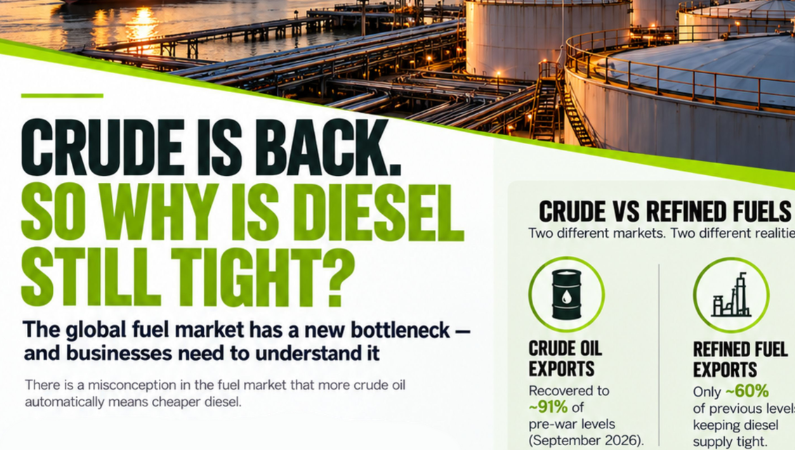
Recent Gulf data illustrates the point. While crude and condensate exports recovered to around 91% of pre-war levels during September, refined fuel exports remained at only about 60%, contributing to shortages of products including diesel and jet fuel.
Dangote therefore represents something bigger than impressive revenue growth: it demonstrates the strategic value of African fuel infrastructure.
For South Africa and the wider region, stronger refining capacity across the continent could eventually create greater diversity in petroleum supply chains and change traditional fuel trade flows.
Africa consumes enormous volumes of energy to mine, manufacture, farm, build and move goods.
Increasingly, the opportunity is to ensure that more of the infrastructure supporting that energy demand is also built in Africa.
The global fuel market has a new bottleneck — and businesses need to understand it
There is a misconception in the fuel market that more crude oil automatically means cheaper diesel.
In October 2026, the global market is proving otherwise.
Oil exports from Gulf producers have been recovering. September flows reached more than 80% of pre-war levels, while crude and condensate exports recovered to approximately 91%. Yet exports of refined fuels remained at only around 60% of previous levels.
That gap matters.
Crude oil still has to be refined into the diesel, petrol and jet fuel that businesses actually use. Damage to refining infrastructure, restricted production and disrupted shipping can therefore keep diesel supply tight even when more crude becomes available.
It is one reason why refining capacity is becoming one of the most important — and least discussed — parts of the global energy story. Current market analysis suggests that greater influence may increasingly shift towards large Asian refining hubs capable of processing crude and supplying finished fuels into international markets.
South Africa is particularly exposed because it imports both crude oil and finished petroleum products. In announcing October’s fuel adjustment, government specifically highlighted shortages caused by lower global petroleum-product inventories, alongside higher crude prices and shipping costs.
For diesel-dependent businesses, watching the oil price alone therefore no longer tells the full story.
Refinery output, global diesel inventories, shipping routes, geopolitical disruption and the rand can all influence the eventual cost and availability of fuel.
The fuel market of 2026 is teaching businesses an important lesson:
The world may have crude oil — but what ultimately keeps your operation moving is refined fuel.
The Diesel Ripple Effect
Your Fuel Bill Is Only the First Cost of October’s Increase
When diesel rises by more than R3 per litre, the obvious impact appears on the fuel invoice.
The bigger impact can appear everywhere else.
October’s increase of approximately R3.24 per litre for 0.005% sulphur diesel comes at a difficult time for South African business. September’s private-sector PMI fell to 49 from 50.5 in August, signalling contraction as new orders weakened, costs increased and supply-chain bottlenecks intensified.
Higher diesel prices add another layer of pressure.
Consider how many times fuel touches a product before it reaches its customer.
A truck delivers raw materials to a manufacturer. Machinery moves those materials. Another vehicle transports finished goods to a distribution centre. From there, another delivery takes them to a retailer or customer.
In agriculture, diesel powers tractors, harvesters, irrigation equipment and the trucks transporting produce. In construction, it powers earthmoving equipment and site machinery. In mining, diesel keeps heavy equipment and support operations moving.
A fuel increase therefore does not remain a fuel cost for long. It becomes a transport cost, production cost, distribution cost and, eventually, a pricing challenge.
Supply-chain specialists are already warning that higher diesel costs can travel throughout the economy because fuel is embedded in the movement of virtually everything.
That changes the question businesses should be asking.
Instead of only asking, “How much more are we paying for diesel?”, ask: “Where will higher diesel costs appear elsewhere in our business?”
Understanding that ripple effect allows management teams to review pricing, margins, supplier arrangements, delivery schedules and operational budgets before the pressure becomes a surprise.
October has made one thing very clear:
Diesel is not just another line on the expense sheet. It is a cost that travels through your entire business.
And the businesses that understand where it travels will be better positioned to protect their margins.