


Momentum Needs Energy
September marks the beginning of spring and, for many South African businesses, the start of an important final stretch of the year. Agriculture is moving through a strong harvest cycle, infrastructure projects are progressing toward implementation and businesses across mining, construction, logistics and manufacturing continue to pursue growth despite a challenging operating environment. At the same time, rising diesel costs remind us that growth must be matched by greater efficiency. At Eco Diesel, we understand that our customers don’t buy fuel simply to fill tanks — they buy it to move products, operate machinery, harvest crops, complete projects and keep people working. That responsibility shapes how we approach every delivery and every customer relationship. As activity increases toward year-end, our commitment remains simple: reliable supply, responsive service and a fuel partner that understands what is at stake when your operation needs to keep moving. Thank you for continuing to trust Eco Diesel. Here’s to a productive spring and a strong final quarter ahead.
— Jessica Le Grange, Chief Executive Officer
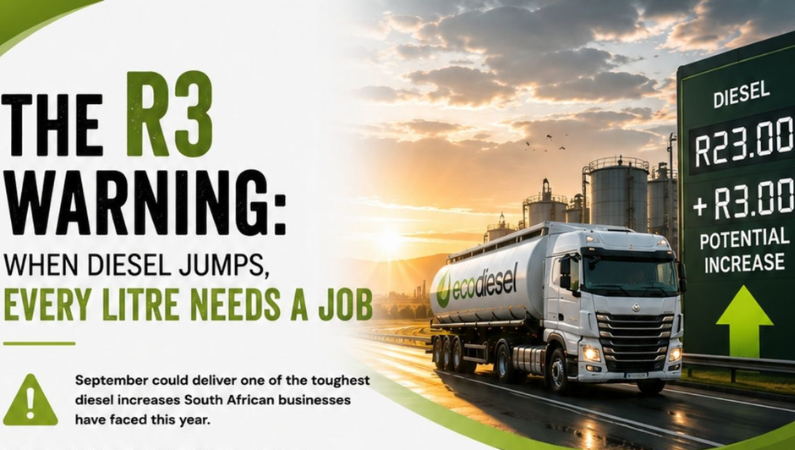
September could deliver one of the toughest diesel increases South African businesses have faced this year.
Late-August market indicators were pointing to an increase approaching R3 per litre for diesel, driven largely by higher international petroleum prices. While final September prices are still to be confirmed, the direction is a warning for every fleet, mine, farm, construction company and diesel-dependent operation: fuel efficiency is about to matter even more.
The challenge is not simply paying more for diesel. It is identifying where expensive litres are producing no commercial value.
A truck idling unnecessarily, a loader running between tasks, an inefficient delivery route, poorly coordinated shifts or equipment left operating during downtime all become more expensive when the diesel price rises.
Consider a business consuming 100,000 litres per month. A R3-per-litre increase represents approximately R300,000 in additional monthly fuel expenditure if consumption remains unchanged.
That changes the conversation.
September should therefore become a fuel-efficiency month. Measure litres against tonnes moved, kilometres travelled, hectares worked, loads delivered or productive machine hours. Look for consumption that cannot be linked directly to output.
Businesses cannot control international oil markets. They can control how efficiently diesel moves through their operations.
At Eco Diesel, our focus is helping customers secure dependable bulk diesel supply in South Africa while making smarter decisions around their fuel requirements.
When diesel becomes more expensive, the objective shouldn’t simply be to buy fuel cheaper.
It should be to make every litre work harder.

South Africa’s infrastructure push is moving closer to the ground
For years, South Africa has talked about infrastructure investment. The conversation is increasingly moving toward implementation.
Infrastructure South Africa’s latest Construction Book identifies 110 infrastructure projects worth approximately R395 billion expected to enter procurement over the next 12 to 18 months. Government has also highlighted a broader infrastructure pipeline approaching R2 trillion, with projects already moving through construction and procurement stages.
For the fuel industry, that matters.
Infrastructure does not begin when a ribbon is cut. It begins with site establishment, earthmoving equipment, generators, cranes, trucks, graders, excavators, subcontractors and thousands of kilometres of material movement.
And much of that activity still runs on diesel.
For contractors hoping to participate in the infrastructure cycle, fuel planning should therefore start alongside project planning.
Where will bulk fuel be stored? What will peak daily consumption look like? Can delivery vehicles safely access the site? How much buffer stock is required? Who controls dispensing? How will consumption be reconciled against equipment and project activity?
Answering those questions before mobilisation reduces the risk of expensive interruptions once machinery arrives.
There is another opportunity too. Major infrastructure projects create secondary demand throughout their supply chains — from transport and quarrying to engineering, manufacturing and equipment hire.
For Eco Diesel customers, South Africa’s infrastructure programme is therefore more than a construction story.
It is a signal to prepare.
Because when projects move from PowerPoint to hard hats, dependable fuel supply becomes part of the infrastructure behind the infrastructure.
17.4 Million Tonnes.
A Bigger Harvest Creates A Bigger Movement Challenge
South Africa’s agricultural story has received a significant boost.
The latest Crop Estimates Committee forecast puts the country’s 2025/26 maize crop at approximately 17.4 million tonnes — around 4.5% higher than the previous season.
That’s good news for agriculture. But a bigger crop creates another challenge: it has to move.
Millions of tonnes of grain don’t travel from fields to silos, processors, feed manufacturers, warehouses and export channels by themselves.
Behind the harvest is an enormous diesel-powered logistics network.
Combines work longer hours. Tractors haul grain. Trucks shuttle between farms and silos. Handling equipment operates at storage facilities. Contractors move between farms while processors and distributors prepare for increased volumes.
This creates an important distinction for agricultural businesses.
Harvest success is measured in tonnes. Profitability is measured in what remains after those tonnes have been produced and moved.
With diesel costs under significant upward pressure entering September, transport efficiency becomes increasingly important.
Farmers and agricultural contractors should look beyond litres purchased and measure diesel per hectare, diesel per tonne harvested and diesel per tonne transported. Those ratios can reveal inefficiencies that the monthly fuel invoice alone cannot.
A stronger harvest should be an opportunity to strengthen margins — not allow higher operating costs to quietly absorb the benefit.
Eco Diesel supports South African agriculture with reliable bulk diesel delivery designed around the realities of seasonal operations.
Because once the crop comes off the land, the next challenge begins:
moving more tonnes without allowing every kilometre to eat into the harvest.
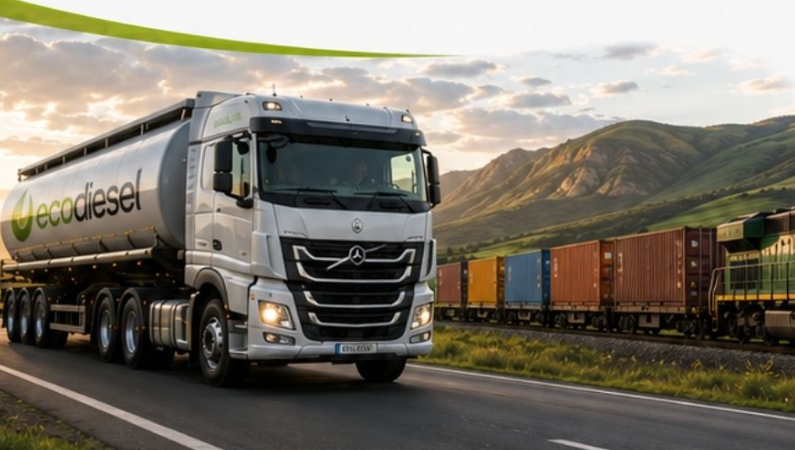
The Rail Comeback
Why Your Next Fuel Strategy May Need To Follow The Tracks
For years, South African freight has steadily shifted towards road. But there are signs that the country’s logistics map could begin changing again.
Statistics South Africa reported that road-freight payload increased 5.4% quarter-on-quarter in Q2 2026, while rail freight declined 2.7%. Yet government and industry are actively working to reverse some of that imbalance.
One development worth watching is the future of South Africa’s regional B-Network railway lines. Transnet Rail Infrastructure Manager is currently gathering information to determine which low-traffic regional lines could be commercially viable, with the process running until 30 September. Agriculture is particularly interested because several of these routes historically connected grain-producing areas with silos, processors and larger freight corridors.
For diesel-dependent businesses, this isn’t simply a rail story.
It’s a fuel-location story.
If greater volumes of grain, minerals, containers and industrial products eventually move by rail, road transport won’t disappear. Its role changes. Trucks increasingly become the critical connection between farms, mines, factories, warehouses and rail terminals.
That can change where fleets travel, where vehicles wait and, importantly, where they need fuel.
Smart operators should therefore think beyond their current delivery routes. Where could tomorrow’s freight hubs develop? Could an intermodal strategy shorten long-haul road kilometres? Would strategically positioned bulk diesel storage reduce unnecessary detours?
South Africa’s logistics future is unlikely to be road or rail.
It will increasingly need to be road and rail working together.
And wherever freight changes direction, fuel strategies need to change with it.
For Eco Diesel, that means understanding not only how much fuel customers require — but where tomorrow’s litres will be needed.
May Be The One That Disappears
When diesel becomes more expensive, fuel theft becomes more expensive too.
And recent events show why businesses should be paying attention.
In August, reports emerged that Eskom — which spends more than R70 billion annually on coal and diesel — was seeking specialist investigators to help tackle criminal syndicates involved in coal and fuel-related crime. Earlier this year, the Hawks arrested 11 suspects following an alleged fuel-theft operation at a plant in Meyerton.
The lesson extends far beyond large state-owned operations.
Any company storing significant quantities of diesel carries an asset that is valuable, portable and difficult to identify once it has disappeared.
The risk isn’t only a tanker being drained overnight.
Fuel losses can happen gradually: small quantities siphoned repeatedly, unauthorised refuelling, manipulated records, unexplained variances between deliveries and dispensing, or fuel being allocated to vehicles and equipment that weren’t operating.
At R20-plus — and potentially much higher — per litre, seemingly small discrepancies can become substantial annual losses.
The solution begins with visibility.
Businesses should reconcile fuel ordered, fuel delivered, fuel stored and fuel dispensed. Unusual consumption patterns should be investigated. Tank access should be controlled. Delivery quantities should be verified. Dispensing records should identify vehicles, equipment, operators and volumes wherever practical.
Most importantly, management should establish what normal consumption looks like.
You cannot easily identify an abnormal pattern if you don’t know your baseline.
Fuel security therefore isn’t simply about fences, locks and cameras. It’s about creating a chain of accountability from the delivery truck to the machine consuming the final litre.
Eco Diesel believes reliable bulk fuel supply includes confidence in what reaches your operation.
Because a litre you buy but never use may be the most expensive litre of all.
Your Peak Season Shouldn’t Arrive Before Your Fuel Does.
September changes the rhythm of business.
Days get longer, agricultural activity accelerates, construction sites gain productive hours and many companies begin pushing towards year-end targets.
That makes September a useful moment to ask a deceptively simple question:
What happens if our fuel demand suddenly increases by 20%?
Many businesses plan diesel requirements around average consumption. But peak periods don’t behave like averages.
A construction project can add machinery. A logistics customer can award an unexpected contract. Agricultural operations can enter an intensive planting or harvesting window. A mine can increase production. Extended operating hours can suddenly push a tank that normally lasts five days towards empty in three.
The mistake is waiting for the low-level warning before responding.
Businesses heading into the final quarter should start modelling their peak diesel demand, not simply last month’s consumption.
Look at planned production. Fleet utilisation. New contracts. Seasonal workloads. Generator requirements. Equipment commissioning. Weekend shifts and public-holiday delivery schedules.
Then ask whether current storage and delivery arrangements can comfortably support that scenario.
The objective isn’t necessarily to keep every tank permanently full. Excess inventory ties up working capital too. The goal is to establish the right balance between fuel availability, storage capacity, delivery frequency and operational risk.
This becomes particularly relevant while South African diesel prices remain exposed to global oil-market volatility. Current late-August projections suggest significant diesel increases could take effect in September, reinforcing the value of accurate forecasting rather than reactive purchasing.
A good fuel strategy should therefore answer three questions before peak activity arrives:
How much will we need? When will we need it? How quickly can we replenish it?
Eco Diesel helps businesses turn those questions into dependable bulk diesel supply.
Because peak season should test your capacity.
Not your ability to find fuel.