


As we move through August, there is a definite sense that the year is shifting gear. Winter is beginning to give way to the promise of spring, and across South Africa, businesses are preparing for what is traditionally a busy final stretch of the year.
For industries that depend on diesel, preparation remains essential. Agriculture is looking toward the next planting season, construction activity continues, transport and logistics networks are carrying growing demands, and mining and industrial operations cannot afford unnecessary interruptions. At the same time, fuel markets remain influenced by international oil prices, exchange-rate movements and global events that can change conditions quickly.
At Eco Diesel, we believe the strongest businesses are those that are ready to adapt.
Our responsibility extends beyond delivering fuel. It is about understanding our customers’ operations, responding when they need us and providing the dependable supply and service that allows them to focus on running their businesses. Every delivery represents a promise that we take seriously.
August is also Women’s Month, and I would like to recognise the remarkable women working across South African businesses, industries and communities. Their leadership, resilience, expertise and determination continue to make an invaluable contribution to our economy and our country.
As we enter the remaining months of 2026, I encourage businesses to look ahead, plan carefully and remain ready for opportunity.
Thank you for your continued trust in Eco Diesel. We are proud to be part of your journey.

South Africa is approaching a major change in fuel quality standards. From July 2027, the country is expected to move to Clean Fuels 2 specifications, aligning petrol and diesel more closely with Euro 5 requirements. The date may still be months away, but for businesses buying trucks, generators, yellow equipment or long-life machinery in 2026, the transition is already relevant.
Why? Because equipment purchased today may still be operating well into the next fuel-standard era. Procurement teams therefore need to think beyond purchase price and ask how new assets fit into changing fuel specifications, emissions technology, maintenance practices and manufacturer requirements.
The transition also creates a useful reason to review older equipment. Mixed-age fleets can have very different sensitivities to fuel quality, filtration, storage conditions and maintenance intervals. Knowing which assets are likely to remain in service after the specification change gives businesses time to speak to OEMs, maintenance providers and fuel partners before the deadline becomes urgent.
This is not a call to replace functioning machinery prematurely. It is a call to make 2026 procurement decisions with 2027 conditions in mind. Long-life assets should be evaluated against the environment in which they will operate, not only the environment in which they are purchased.
For South African transport, mining, construction and industrial businesses, Clean Fuels 2 is more than a technical fuel-industry milestone. It is a fleet-planning milestone. The companies that use the next eleven months to understand compatibility, maintenance and supply implications will enter the transition with fewer surprises and better-informed capital decisions.
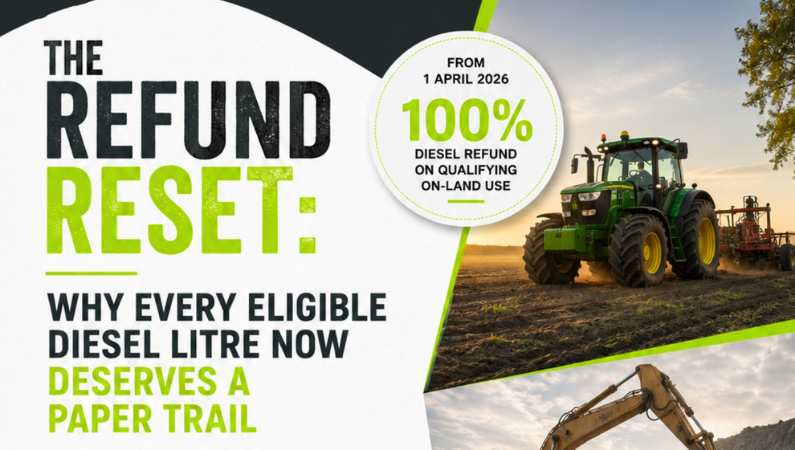
For South Africa’s farmers, forestry operators and mining businesses, 2026 has quietly delivered a change that can alter the economics of diesel-intensive operations. From 1 April, qualifying on-land users under the Diesel Refund Scheme became entitled to claim a refund on 100% of eligible diesel used in qualifying activities. That makes diesel administration more than a back-office exercise; it makes accurate records a direct contributor to margin.
The opportunity, however, comes with a condition: eligible litres must still be defensible. Businesses need to know where fuel went, what activity it supported and whether the transaction can be linked to the records required for a valid claim. A tank total alone does not explain which litres powered qualifying equipment and which litres were used elsewhere.
This is particularly important on farms and mines where diesel can move through several tanks, bowsers, machines and contractors in a single day. The stronger the chain of records, the easier it becomes to separate qualifying consumption from non-qualifying use and reduce uncertainty when returns are prepared.
The smartest response is not to create more paperwork for its own sake. It is to make the fuel trail clearer: delivery records, dispensing records, equipment or vehicle identification, dates, quantities and operational purpose should tell one consistent story.
In a year when every operating cost is under scrutiny, the question is no longer only, “What did we pay per litre?” It is also, “Can we account for every eligible litre?” For diesel-intensive businesses, disciplined recordkeeping can turn fuel administration into measurable financial value.
The Border Burns Too: When a Stationary Truck Becomes a Fuel Cost
South Africa’s road freight sector has entered 2026 with stronger momentum. Road freight activity recovered in the first quarter, while heavy-vehicle traffic increased sharply on key corridors including the N3 and N4. More freight moving is positive for trade, but it also puts a spotlight on a cost that is easy to underestimate: diesel consumed while cargo is barely moving.
Queues at terminals, border posts, loading points and customer sites create a different type of fuel problem. Engines idle, refrigeration units keep running, drivers lose productive hours and delivery schedules compress. The litre burned while waiting may never appear as a separate line on an invoice, yet across a fleet it can become a significant operating expense.
This is why 2026’s freight conversation should move beyond kilometres per litre. Operators should also examine litres per completed trip, idle time by route, turnaround time at major customers and recurring congestion windows. A route that looks shorter on a map may be more expensive if vehicles repeatedly spend hours standing.
The N4 corridor is a useful example. Interim measures at the Lebombo Border Post have improved flow, while work continues towards a more integrated one-stop border model. For fleet managers, changes like these should feed directly into route assumptions and delivery schedules. The new competitive question is not simply how efficiently a truck moves. It is how little fuel the business wastes when the truck cannot move. In a high-volume fleet, reducing avoidable standing time can protect capacity, driver productivity and diesel spend at the same time.

August sits in an awkward space for South African operations. Winter is beginning to loosen its grip, but cold mornings remain a reality across many inland mining, agricultural, construction and logistics operations. And sometimes the first warning that something is wrong with your fuel system does not appear on a spreadsheet — it appears when the first machine of the day struggles to start.
A sluggish morning start is easy to blame on the cold. But when several diesel-powered assets begin showing similar symptoms, it deserves closer attention.
Cold conditions can expose weaknesses that have been developing quietly inside an operation: ageing batteries, restricted filters, moisture in storage tanks, poor fuel housekeeping or equipment that has not been maintained according to its actual workload. The colder start simply makes the problem visible.
That makes August an ideal “early-warning month.”
Instead of treating difficult starts as isolated maintenance incidents, businesses can begin recording them. Which machines are affected? Is the problem occurring after refuelling? Are particular tanks supplying the affected equipment? Have filters required replacement more frequently? Are there unusual changes in consumption or performance?
Patterns matter.
For a mine, farm or construction site running dozens of diesel-powered assets, identifying a developing problem before peak operating demand returns can prevent far more expensive failures later.
The lesson is simple: listen to your equipment before the season changes.
A difficult first start may be telling you something about your fuel, storage system, filtration, maintenance programme or equipment condition that a monthly report cannot.
As South Africa moves toward spring and operating activity begins accelerating in many sectors, August provides a valuable opportunity to investigate the small warning signs.
Because the cheapest breakdown to manage is still the one that never happens.
Fuel discussions in South Africa are increasingly becoming carbon discussions too. In 2026, the national carbon tax increased from R236 to R308 per tonne of carbon dioxide equivalent, while the carbon fuel levy on diesel rose to 23 cents per litre from April. For many businesses, these changes may feel like another tax adjustment. Strategically, they signal something bigger: emissions are becoming a more visible operating and commercial cost.
This matters beyond companies that directly pay carbon tax. Large customers, lenders, investors and supply-chain partners are increasingly asking suppliers to quantify emissions, improve efficiency and demonstrate progress. A transporter, contractor, mine service provider or agricultural supplier may therefore face carbon-related questions through tenders and procurement processes even when its own tax exposure is limited.
Diesel data can become part of the answer. Fuel consumption is one of the clearest operational inputs from which a business can begin understanding fleet and equipment emissions. The goal is not to produce a glossy sustainability claim. It is to establish credible numbers that management can use.
Start with the basics: litres consumed by fleet, site, project or machine; kilometres or production output achieved; unnecessary idling; and recurring areas of poor efficiency. Once fuel use is linked to operational output, businesses can identify where emissions and costs are rising together.
This also changes how efficiency projects should be evaluated. Driver behaviour, route design, preventive maintenance, right-sizing equipment and reducing unnecessary generator hours can produce two benefits at once: lower fuel expenditure and a stronger emissions profile.
For companies bidding into mining, construction, manufacturing and corporate supply chains, that dual benefit may become increasingly valuable.
The important shift for 2026 is this: carbon reporting is moving closer to everyday operations. The diesel tank is no longer only an expense centre. It is also a source of measurable environmental data. Businesses that build reliable fuel baselines now will be better prepared for future reporting requirements, customer expectations and cost pressures.
August places South Africa at the centre of an important regional conversation. The country is hosting the 46th SADC Summit in Durban, following the 2026 SADC Industrialisation Week, where regional value chains, critical-mineral beneficiation, agro-processing, infrastructure, energy and logistics have been prominent themes. For diesel-dependent businesses, this is not distant policy language. It points to where future movement, construction and industrial demand may develop.
Southern Africa is trying to capture more value before commodities leave the region. Instead of exporting only raw materials, the focus is increasingly on processing, manufacturing and beneficiation closer to source. If that direction gains momentum, the operational footprint changes. More plants need to be built. More materials need to move between mines, farms, factories, borders and ports. More contractors, generators, mobile equipment and heavy vehicles enter the chain.
That creates opportunity, but also complexity. Regional growth does not happen on a blank map. Businesses must work across congested corridors, different border processes, long distances and infrastructure that can perform unevenly. The winning supply chains will be those designed around actual operating conditions rather than ideal travel times.
For South African suppliers, contractors and fleet operators, this is a useful moment to look north as well as inward. Which customers are expanding into SADC markets? Which corridors are becoming more important? Where could cross-border projects change diesel demand? Which sites may require reliable bulk delivery because retail access is limited or impractical?
There is also a second opportunity: local beneficiation can create new domestic fuel demand around industrial zones and project sites, particularly in mining-linked provinces and transport corridors.
The story to watch is therefore not simply “more mining” or “more trade.” It is the creation of a denser regional industrial network.
Every new link in that network needs energy and movement. For the bulk-fuel industry, understanding where those links are forming could be as important as watching the oil price itself.