


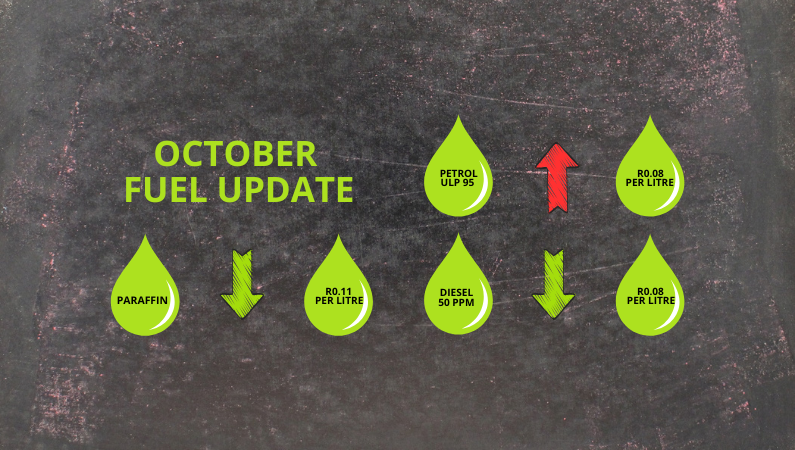
As we enter October, I want to share some encouraging news for our diesel users and fleet operators. The Department of Mineral Resources and Energy (DMRE) has announced this month’s fuel price adjustments, and diesel drivers will see a welcome reduction. Diesel 0.05% will decrease by 10 cents per litre, and diesel 0.005% by 8 cents per litre. For businesses managing high-volume fuel consumption, this translates into meaningful operational savings and an opportunity to plan procurement strategically.
Petrol motorists, however, will experience a mixed picture. Petrol 93 sees a minimal increase of 1 cent per litre, while higher-grade Petrol 95 rises by 8 cents per litre. These changes are influenced by international crude prices and the local Rand/US Dollar exchange rate, which has remained relatively stable. With diesel shortages easing through September, supply levels are normalising, contributing to the current relief.
At Eco Diesel, we understand that fuel costs are a critical factor in your operations. That’s why we continually monitor market trends, exchange rates, and international oil movements, providing you with timely insights to optimise purchasing decisions. By staying informed, our clients can protect margins, avoid surprises, and ensure uninterrupted operations.
We are committed to supporting your business every step of the way. This October, let’s use these adjustments to our advantage, making fuel procurement smarter and more cost-effective. Thank you for trusting Eco Diesel as your partner in keeping your operations running efficiently.
Smart Procurement: Timing Bulk Fuel Buys to Ride Market Waves
Fuel procurement is a strategic lever for businesses managing significant diesel consumption. Understanding market cycles and aligning purchases accordingly can lead to substantial cost savings.
Historical Diesel Price Trends
Over the past decade, South Africa’s diesel prices have exhibited notable fluctuations. For instance, diesel prices ranged from ZAR 11.05 per liter in February 2016 to ZAR 27.45 per liter in October 2022 GlobalPetrolPrices.com. These variations are influenced by global crude oil prices, exchange rates, and local economic factors.
Identifying Procurement Windows
To capitalize on favorable pricing, businesses can monitor:
- Crude Oil Price Cycles: Global oil prices impact local fuel costs. For example, Brent crude prices have experienced significant volatility, affecting refining and transportation expenses
- Exchange Rate Movements: The ZAR/USD exchange rate plays a crucial role, as fuel imports are priced in dollars. A stronger rand can lead to lower fuel costs
- Local Fuel Price Adjustments: The Department of Mineral Resources and Energy (DMRE) regularly adjusts fuel prices, considering factors like international oil prices and exchange rates
Strategic Procurement Tips
- Monitor Market Indicators: Regularly track crude oil prices and exchange rates to anticipate potential cost changes.
- Plan Purchases: Align bulk fuel buys with periods of favorable market conditions to optimize costs.
- Consult Experts: Engage with fuel suppliers and industry analysts to gain insights into market trends and forecasts.
By strategically timing fuel purchases, businesses can enhance profitability and maintain operational efficiency.
The Race for Strategic Fuel Reserves … Is South Africa Doing Enough?
South Africa’s current strategic fuel reserve stands at approximately 21 days, a figure that falls short when compared to global best practices. For instance, the United States maintains a Strategic Petroleum Reserve (SPR) equivalent to 90 days of its fuel consumption. Similarly, Europe has been building up its gas reserves to mitigate supply disruptions.
In contrast, South Africa’s reserve levels are relatively low, which could pose risks in the event of supply disruptions. The country has considered selling additional crude oil from its strategic reserves, but only if global oil prices rise to around $100 per barrel.
For high-volume fuel consumers, such as those in agriculture, logistics, and manufacturing, it’s crucial to proactively manage fuel supply risks. Relying solely on national reserves may not be sufficient.

Recommendations for Bulk Fuel Buyers:
- Negotiate Extended Supply Contracts: Secure agreements with fuel suppliers that ensure a steady supply, even during periods of national shortages.
- Invest in On-Site Storage Solutions: Implement self-bunded tanks or containerized fuel storage to maintain an independent fuel supply.
- Monitor Global Fuel Markets: Stay informed about international oil prices and geopolitical events that could impact fuel availability.
By taking these steps, businesses can enhance their resilience against fuel supply disruptions and ensure continuity of operations.
Optimising Cross-Border Fuel Moves: Lessons from SADC Regions
For businesses operating across Southern Africa—particularly in Zimbabwe, Mozambique, and Botswana—fuel procurement is far more than a logistical task; it is a strategic advantage. Fuel prices and duties vary significantly across these countries. Zimbabwe’s pricing is influenced by government subsidies and foreign currency availability, leading to frequent fluctuations. Botswana’s fuel costs reflect global market trends, while Mozambique’s prices are shaped by import costs and infrastructure limitations. These differences can create arbitrage opportunities, allowing savvy buyers to purchase fuel where it is cheaper and transport it to higher-cost markets, provided transportation costs and regulations are carefully considered.
Cross-border fuel logistics rely heavily on road transport, with major corridors such as the North-South Corridor facilitating movement. However, infrastructure challenges—including border delays, road conditions, and customs procedures—can significantly impact efficiency. Understanding these logistical nuances, staying informed on regional fuel pricing, and ensuring full regulatory compliance are essential for any business seeking to optimise its fuel supply.
By strategically navigating SADC fuel markets, high-volume buyers can enhance operational efficiency, reduce costs, and gain a competitive edge. In a region of fluctuating prices and complex logistics, knowledge and preparation are the keys to turning cross-border fuel movements into a profitable advantage.
Diesel vs Petrol Fleets: Who’s Really Winning on Costs?
For South African businesses managing vehicle fleets, the choice between diesel and petrol is no longer just about fuel availability—it’s about total cost of ownership (TCO). While petrol vehicles often come with a lower upfront purchase price, diesel fleets are increasingly proving their value when efficiency, longevity, and operating costs are considered.
Diesel engines typically deliver better fuel economy, especially for high-mileage vehicles and heavy loads. Over the lifecycle of a fleet, this efficiency translates into substantial savings, particularly when fuel accounts for a significant portion of operating expenses. Maintenance costs are often cited as higher for diesel vehicles due to specialized components, but modern diesel technology has narrowed this gap, offering engines that run longer with fewer major repairs.
Market trends also highlight that diesel remains more cost-effective for commercial fleets with extensive daily mileage. Petrol fleets may still be preferable for urban delivery or lighter workloads, where lower acquisition costs and ease of servicing provide short-term benefits.
High-volume fleet managers are increasingly factoring in not just fuel costs, but the total picture: acquisition, maintenance, residual value, and operational efficiency. Strategic planning can uncover opportunities to optimize routes, fuel procurement, and maintenance schedules, tipping the balance further in favor of diesel for many operations. At Eco Diesel, we understand the intricacies of fleet management and fuel procurement. By combining market insights with tailored supply solutions, we help fleet operators make informed choices that maximize efficiency, minimize costs, and keep operations moving smoothly.